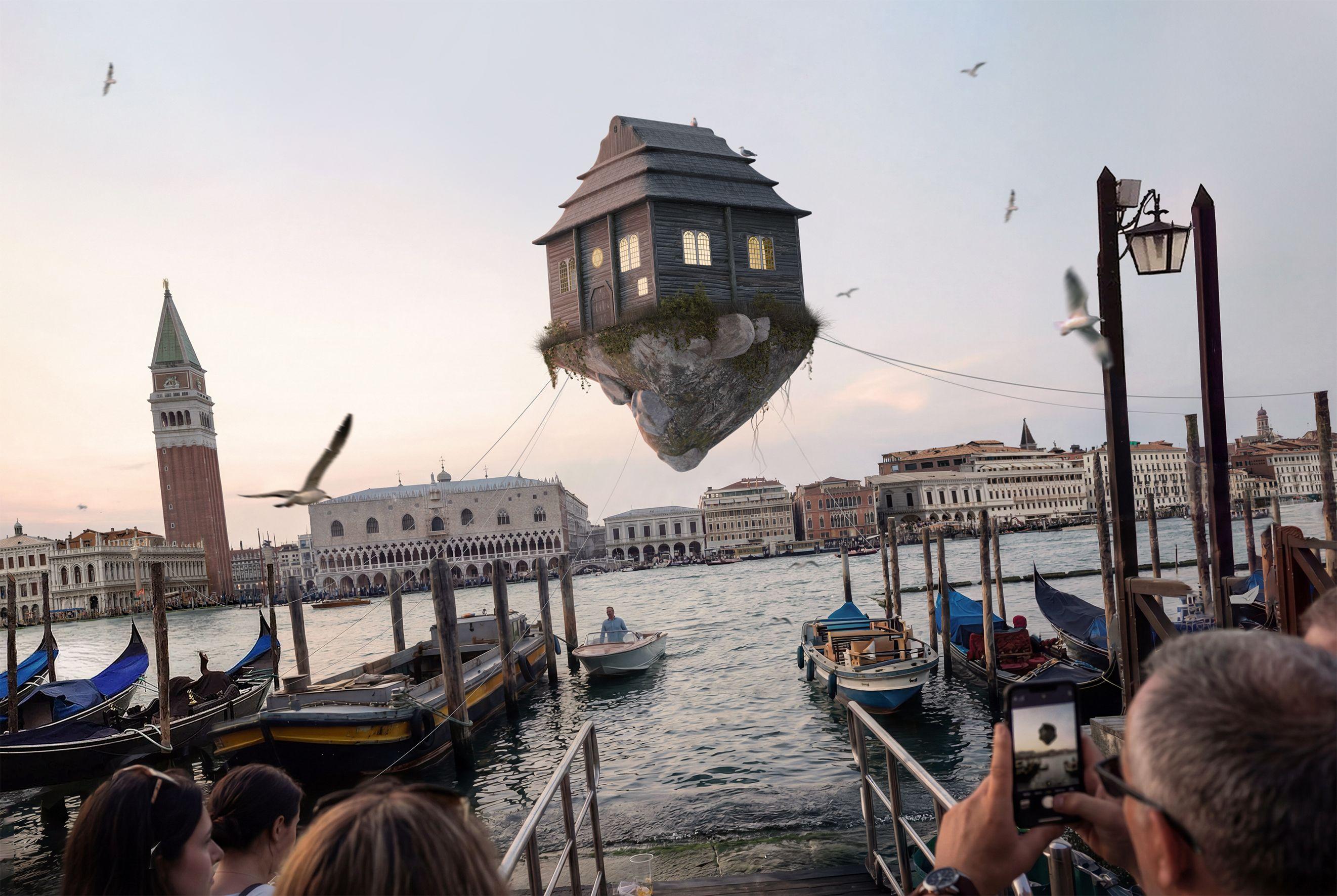
The open-air installation Nabatele, a floating synagogue by the artist and architect Anna Kamyshan, will premiere as a Collateral Event of the 61st International Art Exhibition — La Biennale di Venezia. The project is curated by Maria Veits and Yevgeniy Fiks, and organised by the Montreal Jewish Museum.
On a huge rock suspended in the air, exposed to the forces of nature, a floating synagogue hovers above the city of Venice. Visitors to the Biennale Arte 2026 will be able to witness, day and night, this symbol of eternal light in the sky shining out over the Arsenale.
The Venetian synagogues of the 16th Century were confined to a building’s upper floors, where they remained inconspicuous and unseen. Nabatele, too, inhabits an elevated plain. But unlike those houses of worship of the past, this temple shines proudly for all to see. The project recalls René Magritte’s painting The Castle in the Pyrenees (1959), in which a gigantic stone, surmounted by a castle, levitates above stormy waves, an image often interpreted as unmoored hope and suspended safety. In the same way, Nabatele (a Yiddishized word of Slavic and Semitic origin meaning “call attention to” or “alarm in times of danger”) responds to current global uncertainty, marked by conflict and division, in which wandering is sometimes the best refuge. A symbol of ineffable solidity, Nabatele is a temple for all. Visible to all.