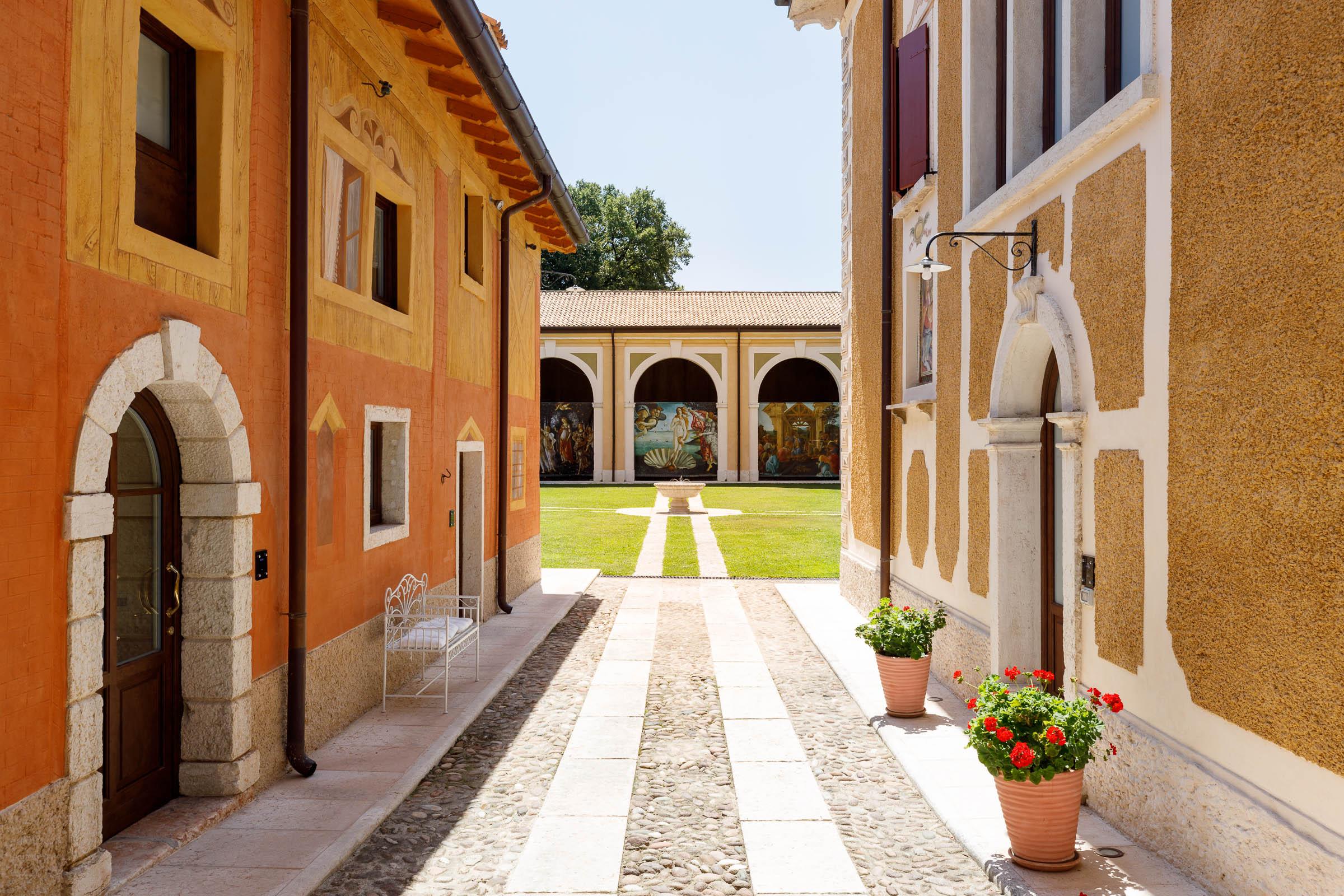
Villa Padovani is a 17th-century residence on the morainic hills of Verona, at the gates of Valpolicella and near Lake Garda. It is protected by the Fine Arts, is part of the Regional Institute of Venetian Villas — winner of the Villa Veneta Award 2018 for restoration — and is associated with the Historical Residences ADSI.
Originally belonging to the Orci family (15th–16th century), it passed to Giuseppe Carminati in 1672, a merchant of Bergamasque cheese, whose coat of arms — a crowned eagle on an agricultural cart, a unique heraldic piece — has adorned the keystone of the portal since 1692. Under the Marinelli family, it experienced a golden age; in 1796, General Masséna established his headquarters there, and legend has it that Napoleon, Masséna, and Moreau tied their horses, returning from Rivoli, to the vine in the courtyard.
Five lions, the highest rating in the Veneto Region: it is a luxury adults-only boutique, with 10 suites, understated luxury — sober elegance, silence, authenticity — for couples and wellness travelers, particularly from DACH, along with cultured Italy, the UK, and North America.
The wellness area, reserved for guests, offers heated pool and jacuzzi in the ancient cellar — water instead of wine — with sauna, steam bath, emotional showers, relaxation, and tailored treatments. The brolo, a walled orchard mentioned in documents since 1672, is the villa's secret garden. The Oratory of the Assumption, erected by the Marinelli family in the late 18th century based on a design by Adriano Cristofoli, houses the altarpiece of Our Lady of La Salette and opens in May for the rosary.
The true peculiarity is the hyperthermal spring, the hottest in the province of Verona: it flows at 53°C and the Health Ministry recognizes its therapeutic properties (balneotherapy for dermatological, artroreumatic, and vascular conditions), practiced at the thermal establishment managed by the medical director. The same water is a renewable geothermal energy source: via exchangers, without combustion, it heats pools, jacuzzis, and sanitary water, reducing CO2 emissions. Here, the ESG identity is born: self-produced heat and zero-kilometer, in a low-impact circular model.