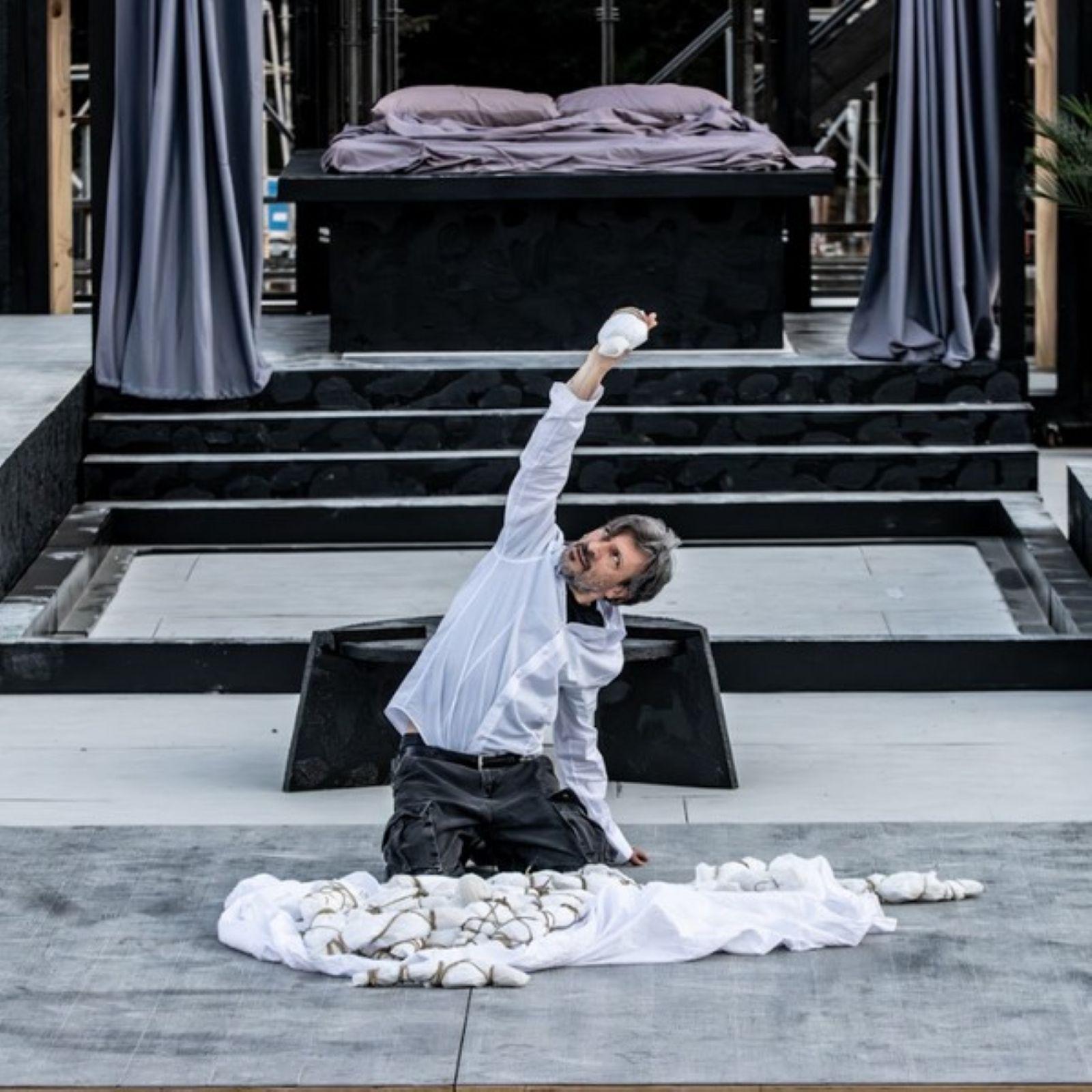
Filippo Dini’s production is a head-on, almost brutal confrontation with the terror of Death in its most scandalous form: that of the sacrificial victim.
Dini interprets Euripides’ play as the West’s first, fundamental meditation on dying, transforming the stage action into a necessary liturgical practice, a secular rite that highlights the sacred inherent in every single moment of life.
Within the framework of this theatrical machine, constructed with geometric and inexorable precision, Euripides enacts a structural rupture that anticipates the revolutions in modern cinematic language by millennia.
Just as Alfred Hitchcock would do centuries later in *Psycho*, the Greek playwright boldly decides to eliminate his protagonist halfway through the play. Alcestis’s death is therefore not an epilogue, but a violent formal shock that marks the exhaustion of the conventional tragic narrative.
This collapse of expectations destabilises the audience and opens the narrative to a phase of feverish uncertainty, where the tragic gives way to a new unease.
At the heart of Dini’s vision, ultimately, lies the mystery of Alcestis, the archetype of devotion that defies the boundaries of time. The woman who ‘returns from over there’ is not the same as the one who left; her sacrifice is reflected in the ‘daily deaths’ of women throughout the ages, marked by a devotion that tragically borders on self-annihilation.