Tocatì - Shared Programme for the Safeguarding of Traditional Games and Sports
Games bring us together: the first Italian inscription in the UNESCO Register of Good Practices
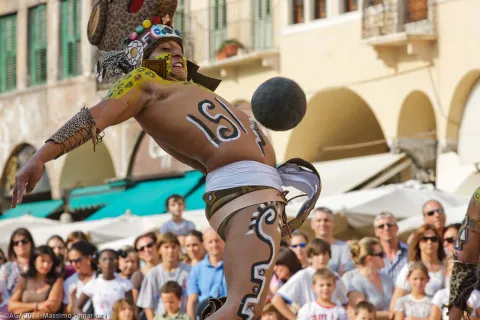
Tocatì is the protagonist of transnational recognition in the UNESCO Register of Good Practices for the Protection of Intangible Cultural Heritage, shared with Belgium, France, Croatia and Cyprus. Thanks to the commitment of volunteers of the Ancient Games Association, this Shared Programme is today a virtuous example of safeguarding traditional games heritage and a participatory cultural model: over the years it has been able to create an international network of communities, institutions and territories engaged in the research and transmission of games-related practices.
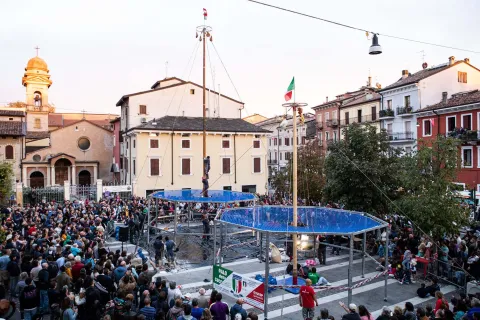
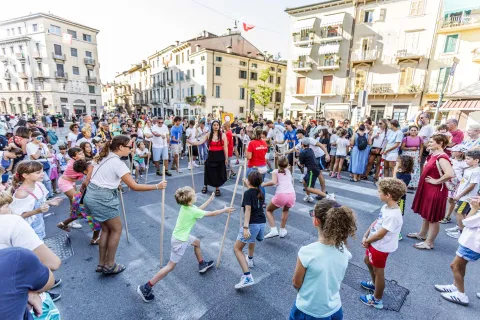
At the heart of this recognition is the International Festival of Street Games, a regular fixture that, since 2003, in the second weekend of September, transforms the streets and squares of the historic centre of Verona into a space open to sharing and discovery. Traditional Games and Sports from all over Italy, concerts and folk dances, workshops for children and conferences for older visitors, wine and gaming experiences and film screenings welcome every year the games communities of a guest of honour, a country or a region of the world, which bring their own authentic traditions to this Scaliger city: from Brittany to China, from Mexico to Flanders, from Catalonia to Hungary, which will be the guest of honour for the next edition?


The art of glass beads

There is a Venice made of industrious silence, expert hands and small lit fires. A town with artisan workshops where, for centuries, tiny treasures have been handcrafted in the form of glass beads. Not simple objects, but fragments of a history that has been recognised as a UNESCO Intangible Cultural Heritage since 2020. The result of a joint effort between Italy and France, this recognition protects not only the techniques – from "light" processing to the threading of the beads – but also the language, collective memory and identity of a community that for centuries has transformed glass into sheer beauty.
Visiting Venice also allows you to see authentic artworks up close, observing the craftsmen at work, being fascinated by a world made of transparencies and colours, and taking away a fragment of it – in the form of jewellery, an emotion or a memory.
Padua’s fourteenth-century fresco cycles
With the proclamation on Saturday, 24 July, 2021 in Fuzhou, China, the serial site "The frescoed cycles of the 14th century" was declared a World Heritage Site, bringing the number of Venetian sites awarded UNESCO recognition to 9.
It is a complex of eight monuments in the historic centre of Padua, inside which frescoed cycles by Giotto, Guariento, Giusto de' Menabuoi, Altichiero da Zevio, Jacopo Avanzi and Jacopo da Verona are preserved.
Unique places that recount the story of the "painted" Padua of the fourteenth century:
- Scrovegni Chapel
- Church of the Saints Philip and James agli Eremitani
- Palazzo della Ragione
- Cathedral Baptistery
- Chapel of the Carrarese Palace
- Basilica and the Convent of the Saint
- Oratory of Saint George
- Oratory of Saint Michael
VISIT THE WEBSITE OF PADOVA URBS PICTA
VISIT THE UNESCO WEBSITE

Venetian defences between the 16th and 17th centuries ‘a land-based state – a sea-based state’
In 2017, UNESCO officially gave this set of assets World Heritage status; the Venetian defences cross several countries between Italy, Croatia and Montenegro, and, in the Veneto region, they included the town of Peschiera del Garda, which acted as a pentagon-shaped fortress.
The Venetian Republic took control of this town in 1440 and immediately recognised its strategic importance from both a military and commercial point of view. During the sixteenth century, armies of engineers and architects therefore worked to consolidate its defence system. The walls, which are still splendidly preserved to this day, were equipped with ramparts and bastions, designed by Guidobaldo della Rovere and built by Michele Sanmicheli.
UNESCO’s recognition confirms the exceptional value of the modern military culture (rampart system) that was developed by the Republic of Venice between the 16th and 17th centuries. The land-based fortifications protected the Serenissima from attacks by other European powers arriving from the north-west, while the defences of the Stato da Mar protected the sea routes and ports of the Adriatic Sea all the way to the Levante. This transnational defence system stretched for more than 1,000 km, between Lombardy and the eastern Adriatic coast.
VISIT THE UNESCO WEBSITE

The Prosecco Hills of Conegliano Valdobbiadene UNESCO Site
With the recognition of the Prosecco Hills of Conegliano and Valdobbiadene, the number of Veneto sites on the UNESCO World Heritage List rises to 8.
In the official description we read that "the area includes a series of hilly chains, which run from east to west, and that follow one after the other from the plains to the Pre-Alps, equidistant from the Dolomites and the Adriatic, which has a positive effect on the climate and the countryside. If Conegliano is home to many wine-related institutes, Valdobbiadene is instead the productive heart of the wine area. The steeply sloping hills make it difficult to mechanize the work and consequently vineyard management has always been in the hands of small producers. It is thanks to this great, peaceful army of workers and thanks to the love for their land that it has been possible to preserve these beautiful hills and create a strong bond between man and the countryside. The result of this strong bond is an extraordinary example of how this ancient culture is strongly rooted in its land ".
The site includes the hilly areas of Valdobbiadene, Miane, Farra di Soligo, Pieve di Soligo, Follina, Cison di Valmarino, Refrontolo, San Pietro di Feletto, Revine Lago, Tarzo, Vidor, Vittorio Veneto to which are added Conegliano, Susegana and San Vendemiano.
VISIT THE PROSECCO HILLS WEBSITE
VISIT THE UNESCO WEBSITE

The pile-dwelling sites
By June 2012 a new pearl was added to the precious collection of gems protected by UNESCO in Veneto: three of the hundred and eleven pile-dwelling sites of the Alpine Arc, entered onto the World Heritage list, are located in Veneto.
The candidacy, promoted by Switzerland, which alone hosts fifty-six archaeological areas, concerned six countries overall: in addition to Italy were Austria, France, Germany and Slovenia, with site selected from over one thousand known in Europe, datable between 5000 and 500 B.C.
Their being located in water-covered land and therefore in an anaerobic environment has allowed the preservation of timber, food remains, tools and artefacts also made from organic materials that would otherwise be perishable. Due to their particular preservation condition these sites are of great scientific interest for the study of the most ancient peasant society of Europe, over 4000 years of human history.
Thanks to the sophisticated equipment available and today's survey techniques, it has been possible to follow with extreme precision the evolution of climate change, the environment and civilisation, from the Neolithic Age to the Iron Age.
Of these archaeological sites, nineteen are located in Italy, over five regions: Lombardy, Trentino-Alto Adige, Veneto, Friuli-Venezia-Giulia and Piedmont; it is still in Italy, on the Lake of Varese, that the most ancient pile-dwelling structures were discovered, dating back to the beginning of the Neolithic period.
There are two locations concerned within the province of Verona: one in Peschiera del Garda, between Belvedere and Frassino, and one at Tombola, near Cerea; an important site was identified in the province of Padua in the Laghetto della Costa at Arquà Petrarca, at the foot of the Euganean Hills.
VISIT THE UNESCO WEBSITE

The City of Vicenza and the Palladian Villas
Inscribed a World Heritage Site by UNESCO in 1994, Vicenza’s majestic architecture that gives the city its unique appearance is the work of only one man: Andrea Palladio. The architectural genius of this Renaissance Master is most evident in his buildings whose distinct architectural elegance, balance and harmony is unique, and were able to change the urban layout of the city and a part of the landscape.
One need think only of the magnificence of the Palladian Basilica, the Olympic Theatre, the Loggia del Capitaniato and the extraordinary Villa Almerico Capra “La Rotonda”.
The Site “City of Vicenza and the Palladian Villas of the Veneto" is a serial site with two inscriptions by UNESCO. Inscribed on the World Heritage List in 1994, the site initially comprised only the city of Vicenza with its 23 buildings and 3 suburban villas attributed to Palladio; 21 villas located in several Veneto provinces were later included in the 1996 site extension.
VISIT THE WEBSITE OF VICENZA AND THE PALLADIAN VILLAS
VISIT THE UNESCO WEBSITE

The City of Verona
Verona was inscribed in the World Heritage list in 2000. The reason for the inscription reads as follows: "The historic city of Verona was founded in the 1st century B.C. It particularly flourished under the rule of the Scaligeri family in the 13th and 14th centuries and as part of the Republic of Venice from the 15th to 18th centuries. Verona has preserved a remarkable number of monuments from antiquity, the medieval and Renaissance periods, and represents an outstanding example of a military stronghold. It is a city of culture and art".
The traces of its glorious past are today still evident, everywhere. After Rome, Verona is considered to be the second most important city in Italy for its rich and remarkably preserved Roman remains such as the Amphitheatre Arena, the Roman Theatre, Ponte Pietra, Arco dei Gavi, the Porta Leoni and Porta Borsari, to name but a few. Also noteworthy are the signs of its political and economic development after the year 1000 with churches, palaces and monuments built under the rule of the Scaligeri. The city contains many other remarkable historical and artistic remains such as the walls, gates and ramparts of the Republic of Venice and the strongholds dating to the Austrian empire.
VISIT THE VERONA WEBSITE
VISIT THE UNESCO WEBSITE

Venice and its lagoon
Unique as it is "Venice and its Lagoon" certainly need no presentation and was inscribed as a UNESCO World Heritage Site in 1987 in “recognition of its unique historical, archaeological, urban and artistic heritage and exceptional cultural traditions, integrated into an extraordinary natural landscape”.
The Site is considered to be a "cultural landscape" that symbolizes the work of man and nature in time under the influence of physical constraints and environmental, social, economic and cultural opportunities. In this extraordinary setting, history and art are reflected in the calm waters of the lagoon, a wide coastal basin of more than 70 thousand hectares between the mouths of the River Brenta and the River Sile.
A lagoon that is an exceptional example of semi-lake habitat but which unfortunately has become extremely vulnerable due to climate change. The UNESCO Site therefore also protects the eight municipalities on the lagoon: Campagna Lupia, Cavallino Treporti, Chioggia, Codevigo, Jesolo, Mira, Musile di Piave and Quarto d 'Altino.
VISIT THE VENICE WEBSITE
VISIT THE UNESCO WEBSITE

The Dolomites
“Their dramatic vertical and pale coloured peaks in a variety of distinctive sculptural forms is extraordinary in a global context. These mountains also contain an internationally important combination of earth science values”. So reads the Seville declaration of 2009 when the Dolomites were inscribed as a World Heritage Site.
Most of the Dolomites and the UNESCO systems are in Belluno Province, which has five of the nine systems:
- Pelmo and Croda da Lago
- Marmolada
- Pale di San Martino, Pale di San Lucano, Dolomiti Bellunesi and Vette Feltrine
- The Northern Dolomites
- Dolomiti Friulane and d’Oltre Piave
A natural heritage of exceptional beauty and value recognized by the whole world. Just as spectacular and unique is phenomenon known as “enrosadira”, being the colouring that encapsulates the peaks of the Dolomites making them glow in different tones ranging from pink to dark red.
VISIT THE WEBSITE OF THE DOLOMITI UNESCO FOUNDATION
VISIT THE UNESCO WEBSITE
