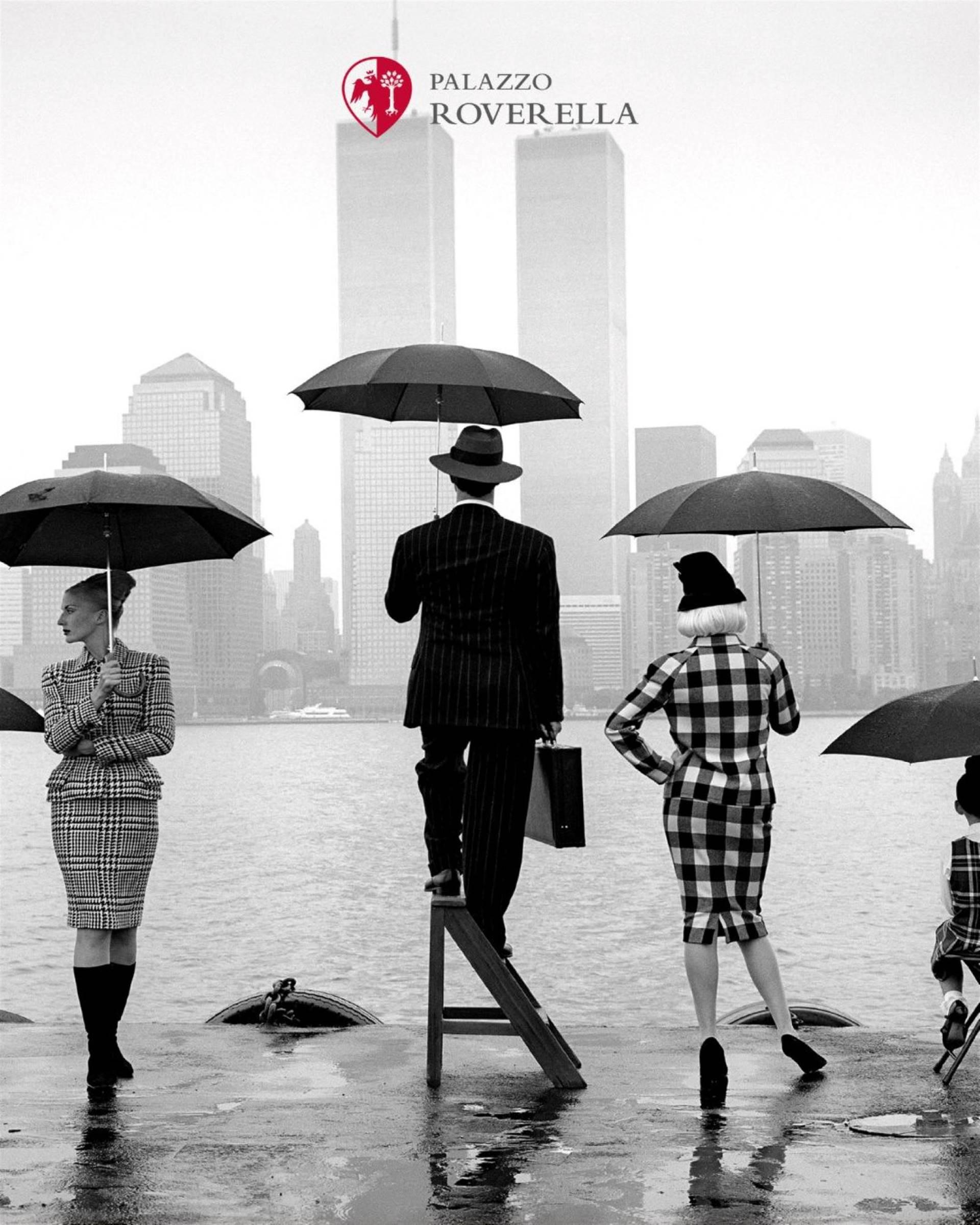
For the first time in Italy, Palazzo Roverella hosts a major exhibition dedicated to Rodney Smith, one of the most iconic New York photographers of the 20th century. With over one hundred images, the exhibition retraces the author’s entire career, celebrating his refined combination of elegance, compositional rigor and surreal humor. His photographs evoke worlds suspended between reality and dream, in which references to Magritte’s painting and the cinema of Hitchcock and Wes Anderson enrich a unique visual poetics, made of formal harmony and symbolic narration. The exhibition path, divided into six sections, leads the visitor along suspended scenarios, rich in grace and mystery, accompanying him, through a dialogue built on emotion and wonder, to the discovery of an author who was able to transform the ordinary into the extraordinary.
Immersing yourself in Rodney Smith’s universe means entering a world where time stands still and lightness becomes form. Each shot by Rodney Smith is an invitation to cross a threshold: that between the real and the imaginary, between rigor and levity, between concreteness and lyricism. His images – never retouched, illuminated only by natural light – move between the nostalgia of black and white and the discovery of chromaticism, providing an intimate but at the same time universal vision. Rodney Smith observes reality to transform it: he plays with gravity, reflects on spaces, goes beyond symbolic and temporal canons. A student and follower of great masters such as Walker Evans and Cartier-Bresson, inspired by cinema and philosophy, he has made photography the language to offer an invitation to stop, observe and let yourself be transported, with wonder, into the suspended moment where everything seems possible.
Rodney Smith’s work draws inspiration from multiple places and historical periods. From time to time it draws on literature, poetry, philosophy; it goes through the history of painting far and wide to explore the depths of photography. And as it takes shape and is built, like a thousand-year-old cathedral that tends towards the sky, this work rises, enclosing within itself all those suggestions, declining them with the greatest sensitivity. Precision, balance and harmony of shapes, masses and volumes: each image by Rodney Smith seems to be governed by the laws of mathematics. Ultimately, they are all tiny architectures that are at once ephemeral and eternal and that respond to the ancestral idea of the divine proportion, to the golden section, to the sacred equation at the basis of many masterpieces in the history of art and nature, and which Smith’s work continues to decline to infinity.