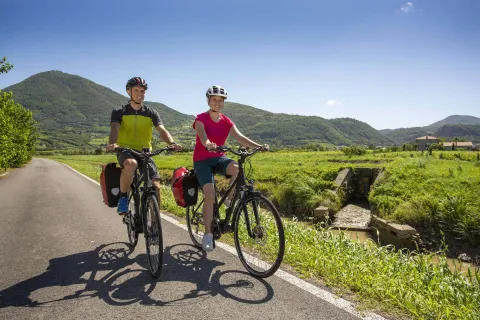
From Padua, the Euganean Hills appear on the horizon as isolated wavy lines with a surprising variety of shapes: conical profiles overhang reliefs with gentle slopes. This is the first impression that strikes those who approach the Regional Park of the Euganean Hills, but it is only by entering the territory that you can discover the extraordinary treasures of this corner of Veneto.
The series begins with Villa Molin, at the gates of the City of the Saint and continues to Battaglia Terme with Catajo Castle, the imposing home of the Obizzi family, then Villa Selvatico and a little further on with Villa Emo and its typical Italian garden. This first section runs on the banks of the Battaglia Canal, an artificial waterway built by the municipality of Padua from 1189 to 1209, raised above the ground floor and fed by the waters of the Bacchiglione.
Once you have reached the walled city of Monselice, you can visit the square, the castle and the nearby promenade of the Jubilee Sanctuary of the Seven Churches on the Colle della Rocca, where the Mastio Federiciano stands. Resuming the journey in a southerly direction on the embankment of the Bisatto Canal, you will cross large reclamation areas, with a view extending over the entire southern part of the Euganean Hills. To the west, Este stands out with its fourteenth-century castle. The historic centre is worth a visit, with colonnaded buildings, squares, museums, churches and ceramics workshops.
Continuing along the Bisatto Canal, you will reach Bomba, a town where the waterway flanks an ancient furnace housing the Geo-Paleontological Museum of the Euganean Hills. The route continues towards Monte di Lozzo, where the fourteenth-century Castle of Valbona stands intact, then reaching Vo’ Vecchio with an atmosphere of yesteryear. In Bastia di Rovolon, the cycle path crosses the famous Euganean vineyards where wonderful red wines and the fragrant Moscato Fior d'Arancio are produced.
Once you reach the northeast end of the hills, you should stop to visit the Abbey of Praglia, an authentic Renaissance treasure and an important centre of Benedictine spirituality. The last stretch towards Padua passes through the Thermal Baths of Abano and Montegrotto, European capitals of therapy and well-being.