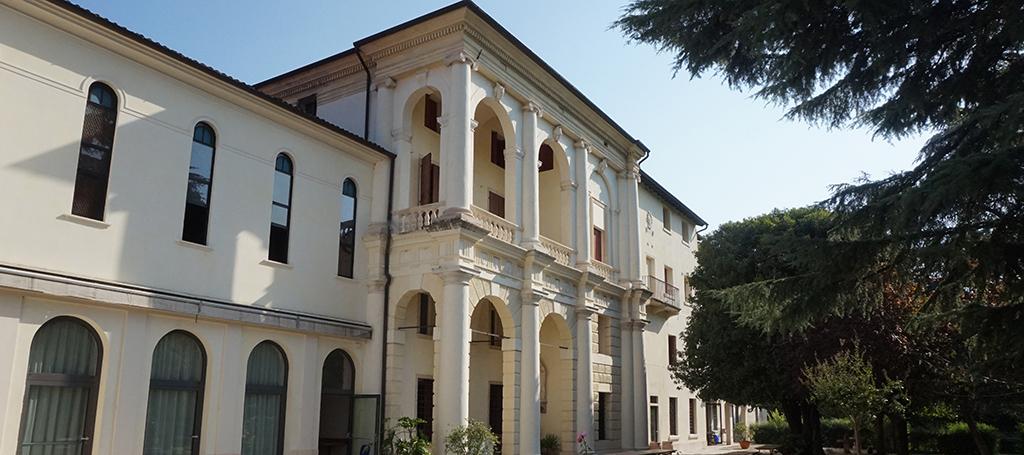
Villa Cordellina Lombardi
<p><b>Closure of the site for technical setups: July 25-26, 2025</b></p><p><b>Info for booking visits:</b> 0444/696546 - info@prolocoaltemontecchio.it</p><p><b>Contact for logistics</b>: 0444/696085 - 348/6098260</p><p><b>Contact for organizing events</b>: 0444/908160 or villa.cordellina@provincia.vicenza.it</p><p><b>Open to the public from April 1st to December 31st on the following days and times</b>:<br><br>- Tuesday and Thursday from 3:00 PM to 6:00 PM (<b>by reservation</b> contact: tel. 0444/696546 or info@prolocoaltemontecchio.it)<br>- Saturday and Sunday from 3:00 PM to 6:30 PM (<b>without reservation</b>)<br></p><p>It is advisable to always contact <b>the villa</b> before a visit (0444/696546 - info@prolocoaltemontecchio.it) to verify that there are no events causing the closure of the complex.</p><p>For information regarding the organization of events (conferences, seminars, workshops, meetings, culturally and socially significant events) write to <b>villa.cordellina@provincia.vicenza.it or contact 0444/908160</b></p><p><b>Note:</b> <b>Access for animals is prohibited in the monumental area (Villa, Hall of Windows, rustic annexes, and accommodations).<br>Access for animals in the green area (dogs or cats) is allowed only if held in arms and on a leash.</b></p><p><b>TICKET PRICES:</b></p><ul><li>Individual full entrance: <b>€ 6.00</b></li> <li>Individual reduced entrance: <b>€ 4.00</b> (60 Card)</li> <li>Group entrance for more than 15 people: <b>€ 4.00 - winter period for groups 25 people € 6.00<br></b></li> <li>Student entrance: <b>€ 2.00</b></li> <li>Free entrance <b>for minors up to 12 years, disabled individuals, and accompanying teachers</li> <li>Group entrance outside hours (by agreement and reservation): <b>€ 6.00<br></b></li> <li>Entrance to Chiesetta Pizzocaro: <b>€ 50.00</b> per group</li> </ul> <ul></ul> <p><b>Group visits by reservation</b></p><p><b>Note: In case of conferences or events, visits are suspended</b></p>
Villa Cordellina Molin, Marzotto, Lombardi - Villa Cordellina Lombardi <br>Catalog Number IRVV (Regional Institute of Venetian Villas): A0500004615
Villa Ferramosca, Sesso, Beggiato, Monti, Berti
Villa Ferramosca, Sesso, Beggiato, Monti, Berti stands on the ancient foundations of a medieval castle in the Barbano area, nestled in the countryside of Vicenza. Historical and architectural studies confirm that, in 1565, the renowned jurist Girolamo Ferramosca commissioned the construction of the villa from architects Giandomenico and Vincenzo Scamozzi, father and son, both central figures in Venetian Renaissance architecture. The project is deeply rooted in the noble Palladian tradition, showcasing both monumental grandeur and refined compositional elegance—qualities that continue to captivate today. The villa enjoyed its golden age between the 16th and 17th centuries, during which time the Ferramosca family, a prominent house of the ancient Vicentine nobility, held the feudal estate of Barbano along with numerous other properties throughout the province. Celebrated for their refined tastes and high cultural standing, the Ferramosca were also granted the prestigious title of Venetian nobility in the 17th century. Through a shrewd policy of strategic marriages, the family allied themselves with other important local lineages, thereby further consolidating their wealth and influence. By the late 18th century, following the extinction of the Ferramosca family, the villa passed first to the Sesso family, then to the Antoni Zaccaria, and finally to its last noble residents, the Beggiato family. Today, after decades of neglect, the villa is experiencing a new season of renewal, thanks to an ambitious architectural and structural restoration. The project, passionately and meticulously led by the current owners, seeks to restore the villa to its original splendor. It also aims to enhance the entire estate, interpreting it as part of a broader cultural and social vision. The ultimate goal is to return this landmark to the community as a place of identity, capable of telling the story of the art, ingenuity, and traditions that shaped centuries of both rural and aristocratic life.
Contacts and Visits
Villa Ferramosca is open to visitors by appointment only, due to ongoing restoration work and in compliance with current safety regulations.
To book a visit: (+39) 349 3531847
<p>Villa Ferramosca, Sesso, Beggiato, Monti, Berti is <b>open for visits by appointment</b>, subject to ongoing restoration work and in accordance with the safety plan provisions. </p><p><i></i>Contact person: Alberto Marzaro </p><p>Phone: <b>349 353 1847</b></p><p>Email: <b>alberto@marzaro.net</b></p><p><br></p><p><br></p>
Villa Ferramosca, Sesso, Beggiato, Monti, Berti - Villa Ferramosca, Sesso, Beggiato. <br>Catalog Number IRVV (Regional Institute of Venetian Villas): A0500001452
Villa Pojana
Villa Pojana Miniscalchi-Erizzo-Bettero-Chiarelli was commissioned to the architect Andrea Palladio by the Vicentine Bonifacio Pojana, a member of a family closely tied to the Republic of San Marco. The project, conceived by Palladio in the late 1540s, was completed in 1563, although only one barchessa (outbuilding) from the original design was actually built. The villa was finished in the following century, when the descendants of Bonifacio Pojana had an additional building constructed on the right side, with window mouldings inspired by Palladio's façade design.
The main floor features a large rectangular hall, covered by a barrel vault, which dominates the entire space. Surrounding it are smaller rooms, each covered by different types of vaults, evoking the symbolism of ancient thermal structures and creating a sense of continuity with classical antiquity.
Since 1996, Villa Pojana has been included in the UNESCO World Heritage List, along with the other Palladian villas of Veneto, recognized for their outstanding historical and architectural value.
.<p>The Villa is open to the public every<b> Wednesday, Saturday, Sunday and on public holidays, from 10:00 AM to 1:00 PM and from 3:00 PM to 6:00 PM.</b><br><b>On the first Sunday of each month, it will be possible to visit it for free with continuous hours, from 10:00 AM to 6:00 PM. </b>It is specified that the free entry is only on the first Sunday of the month. <p>For more details:<br>• Email: info@villapoiana.it<br>• Tel: +39 351 322 6843 (during opening hours)</p></p><p><br></p>
<p><b>Entrance Fees</b></p> <ul> <li> <p><b>Adults (over 18 years)</b>: € 5.00</p> </li> <li> <p><b>Family groups</b> (parents and children):</p> <ul> <li> <p>3 people: € 10.00</p> </li> <li> <p>4 people: € 12.00</p> </li> <li> <p>5 people: € 15.00</p> </li> <li> <p>More than 5 people: € 20.00</p> </li> </ul> </li> <li> <p><b>University students</b> (Italian or foreign): € 2.00</p> </li> <li> <p><b>Members of cultural, environmental, and landscape enhancement organizations and associations affiliated with IRVV</b>: € 2.00</p> </li> <li> <p><b>Groups</b> (max. 25 people per group; beyond that number, the visit will be divided and staggered for protection and safety needs): € 75.00</p> </li> <li> <p><b>School visits</b> (per class, max. 25 people; beyond that number, the visit will be divided and staggered for protection and safety needs): € 25.00</p> </li> <li> <p><b>Combined ticket "TOUR Ville Venete IRVV"</b> (if active and valid until 31.12 of the year of purchase, for Villa Venier-Contarini in Mira (VE) and Villa Pojana in Pojana Maggiore (VI)): € 7.00</p> </li> </ul> <p><b>Free entry for:</b></p> <ul> <li> <p><b>Children and teenagers under 18 years</b></p> </li> <li> <p><b>Adults over 65 years</b></p> </li> <li> <p><b>Disabled and/or vulnerable persons</b> (including one companion)</p> </li> <li> <p><b>Pregnant women</b></p> </li> <li> <p><b>Birthday celebrants on their birthday</b></p> </li> <li> <p><b>Married couples on their wedding anniversary</b></p></li> </ul>
Villa Pojana, Miniscalchi-Erizzo, Bettero, Chiarello - Villa Pojana <br>Catalog Number IRVV (Regional Institute of Venetian Villas): A0500001513
Villa Gualdo, Valmarana, Vendramin Calergi ora Palazzo Comunale
In the heart of the Venetian countryside stands an architectural masterpiece designed by Giuseppe Gualdo: Villa Gualdo, Valmarana, Vendramin Calergi now Palazzo Comunale, an imposing residence, with a central body on four floors flanked by two symmetrical wings. The elegance and majesty of the building are enhanced by three scenic staircases and side entrances. Among the treasures it houses is the splendid sixteenth-century lavabo in the atrium, attributed to the workshop of Palladian masters Giovanni Di Giacomo da Porlezza and Girolamo Pittoni da Lumignano. In the noble hall, now the council chamber, five doors with a horizontal entablature frame stucco busts of Roman emperors, probably from the Neoclassical era. The villa also hosts works by U. Coromaldi and Luigi Tarra, gifts from Marquis Giuseppe Roi, and features a permanent exhibition dedicated to Antonio Fogazzaro. The architectural context is enriched by the Little Church of the Heroes (1832), with a painting by G. Busato, and the former convent of San Marco, now belonging to the diocese of Padua, where Fogazzaro wrote the story Pereat Rocus.
Villa Gioia Grande
The villa dates back to the early 18th century (with an original core from the 16th century) and represents a typical example of the style known as "rustic 700", which is distinguished by its sobriety and purity of lines from the lavish and ornate style of other major residences in the Veneto countryside. According to tradition, it was also built by an aristocratic family in the hinterland of the Republic of Venice as a summer residence. The villa has passed through various noble families: Counts Bonaguro, Counts Vanzo, Counts Caffo, Baron Sturm von Hirschfeld, and others, until, following the common fate of such properties, the lands associated with it were gradually sold and dispersed. In 1978, the residence and park were purchased by the current owners, who restored them with great care and named them "Gioiagrande" for their serene beauty.
Excellences of the villa: The villa is surrounded by a large agricultural estate, with a pleasant landscape and lush vegetation due to the soil's fertility and the abundance of waters derived from the Brenta River through an ancient and still effective canalization system. The extensive park, measuring 25,000 square meters, perhaps designed by the botanist Parolini, is maintained to a perfect standard: centuries-old plants, flowers, shrubs, watercourses, paths and walks, bridges and little bridges envelop and surround the villa, creating a pleasant and relaxing atmosphere.
Excellences of the context: Villa "Gioiagrande" is located in a particularly fortunate position as it is a short distance from well-known centers and cities such as: Bassano del Grappa, an ancient city and birthplace of the painters Da Ponte; Marostica, a walled city famous for its chess game; Castelfranco Veneto, the home of Giorgione; Cittadella, an ancient medieval village; Asolo, a beautiful village set in the hills of the Treviso region.
Monday from 9:30 AM to 10:30 AM
Villa Morosini, Lampertico, Bonguro, Vanzo Mercante, Caffo, Sturm, Marinotti, Cerantola-Sandri known as "Gioia Grande" - Villa Gioiagrande <br>Catalog Number IRVV (Regional Institute of Venetian Villas): A0500002934
Villa Pisani Bonetti
Villa Pisani Bonetti, included in the UNESCO World Heritage List since 1996, was planned by Andrea Palladio in 1541, the date of his return from his first journey to Rome, and was built between 1544 and 1545. It is perhaps the most representative example of his early period and it marked the beginning of his collaboration with the Serene Republic of Venice.
The Villa was inspired by the ancient buildings of Rome, in particular the public baths; it reflected their monumentality and, in doing so, was a potent symbol of the new “fiefdoms” and the power of Venice on the mainland.
The location of the Villa on a river meant that there was easy access to Venice for the transport of people, materials and produce, and making it particularly convenient for the Pisani family when they came in the summer months.
The Villa is now in a perfect state of preservation thanks to the work of both the previous and the present owners; it may be visited all the year round by appointment.
The Barchessa, originally a rustic construction with large arched canopies for essentially agricultural use, which today, after a careful restoration and complete restoration, comes back to life, preserved and enhanced, in the 21st century, as a relais, event space and restaurant .
<p>The Villa can be visited all year round by appointment<br>ph +39 0444 831104 <br>villa@villapisanibonetti.it </p>
<p>Villa Pisani, Bonetti<br>Catalog Number IRVV (Regional Institute of Venetian Villas): A0500001476<br></p>
Villa Thiene Valmarana
In 1497, in Quinto, Giacomo Thiene, son of Marco, makes his will at the manor house and orders to be buried in the cemetery of S. Giorgio. Thus, there is already a villa and the lord resides there for long periods of the year. The presence of a lord in these lands is destined to strengthen more and more in the following centuries. From this moment on, the Thiene family will increasingly bind their name to the history of Venetian architecture and Palladio.
Excellences of the villa: "The drawings that follow are of the fabric of Count Ottavio Thiene in Quinto, his villa. It was begun by the happy memory of Count Marc'Antonio his father, and by Count Adriano his uncle: the site is very beautiful as it has, on one side, the Tesina, and on the other, a large branch of the said river.” Thus Andrea Palladio introduces the project of Villa Thiene in his treatise “The Four Books of Architecture.” However, it should be emphasized a fundamental aspect: the drawing included in the Treatise is the result of a radical theoretical reworking that came later. In fact, the first project for this villa is less complex but more attentive to the environmental context than that of 1570. The villa was built around 1545/46 for Marcantonio Thiene. On the ground floor, the council hall preserves the sixteenth-century fresco decoration by Giovanni De Mio from Schio. The villa, having passed from the Thiene family to the Valmarana family, has been a municipal seat since 1871. It has been UNESCO heritage since 1996.
Excellences of the context: -The Church of San Giorgio, which houses paintings from the Maganza school and a valuable baptismal font from the 1700s with the coat of arms of the Thiene family. -In contrada Valproto, in the 1200s, there was the ancient church of San Michele Arcangelo and on the ancient bell tower still visible, the stone coat of arms of the Thiene family. -The Church of Lanzè dates back to 1927 and is in neoclassical style, created by local architects. -In the location of Quintarello, we find Villa Tacchi-Fagan, notable for the vast park designed by architect Giorgio Massari (18th century). -Older is the villa De Tacchi Franco also known as "Cà Prigioni", whose structure incorporates a core that possibly dates back to the times of the lords of Lanzè. -Another testimony to the summer residences of the bourgeoisie, built between the Seventeenth and Eighteenth centuries, is the Uderzo villa, now Cavinato, and the Galvanin Rigon villa in Lanzè.
<b>To visit Villa Thiene contact e-mail:</b> cultura.istruzione@comune.quintovicentino.vi.it
Villa Thiene, Valmarana - Villa Thiene municipal seat <br>Catalog number IRVV (Regional Institute for Venetian Villas): A0500001519
Villa Groppato, Ferrari, Tassoni, Veronese detta "Vescova"
Nestled in the millennia-old history of Brendola (VI), Villa Vescova – formerly known as Villa Veronese – stands on the edge of the ancient Roman Castrum, in one of the village’s oldest quarters. Once the residence of the Bishop Count, who oversaw the territory from the nearby fortress, the villa takes its name from the episcopal presence that lasted until the sixteenth century. Transferred to private ownership between the sixteenth and seventeenth centuries, the villa was restored in the 1940s by Ugo Veronese, who commissioned architect Dal Conte for the renovation. Neoclassical elements were added to the central structure, while the elegant double staircase and the arched passageway leading to the rear park – still home to centuries-old olive trees – were preserved. Following the death of Veronese’s wife, with no heirs, the villa was donated to the Diocese of Vicenza, which now entrusts its care to the Diakonia Onlus Association. Through the “Cultivating Hope” project, the villa continues to thrive as a place of memory, beauty, and renewal.
<p>The Villa is open for visits by reservation. Visits can take place during office hours from 9:00 AM to 1:00 PM, Monday to Friday, by appointment only. It is also possible to visit the Villa on weekends or in the afternoons, always by appointment, with a minimum of 10 participants per visit.</p><p>For information and reservations:</p><ul><li><i></i>0444 12 70 209</li> <li><i></i>info@villavescova.it</li> </ul> <p>Things to know:</p><p>A contribution is required to support the active social inclusion project at the facility.</p><p>Educational activities are organized for schools of all levels and events. </p><p>Parking:</p><ul><li><i></i>Piazza del Popolo (in front of the Church of San Michele)</li> <li><i></i>Public parking located between Via Roma and Via Zanella</li> </ul> <p>People with disabilities or with mobility difficulties will be allowed to park inside the courtyard of the villa.<br></p>
Villa Groppato, Ferrari, Tassoni, Veronese known as "Bishop" - Villa Bishop <br>Catalog Number IRVV (Regional Institute of Venetian Villas): A0500001422
Giardino di Villa Godi, Da Porto Bissari, Piovene Porto Godi
The villa is located near the city of Vicenza. Villa Godi, Piovene was built in 1597 by the architect Vincenzo Scamozzi. The layout of the central body corresponds exactly to the usual scheme of the Venetian villas of the 16th century: a large central hall, flanked by three smaller rooms on each side. The chapel located on one side of the park, an excellent testimony of the 17th century Vicenza, is attributed to Antonio Pizzoccaro.
Excellences of the villa: The villa has been recently restored to host events. It has service areas and heating. A vast centennial park of about 60,000 square meters, with an avenue of centuries-old plane trees at the back of the villa, allows for moments of pleasant relaxation. Surrounded by a large fish pond, there is ample parking for cars and buses within the park.
<p>Admission ticket: Euro 5.00</p>
Garden of Villa Godi, Da Porto Bassani, Piovene Porto Godi<br>Catalog Number IRVV (Regional Institute of Venetian Villas): A0500001457
Villa Tornieri
<b>To visit Villa Thiene contact e-mail:</b> cultura.istruzione@comune.quintovicentino.vi.it
Villa Cogollo, Arsiero, Tornieri, Da Schio, Villardi, Mosconi, Zarontello <br>Catalog Number IRVV (Regional Institute of Venetian Villas): A05000001548