PGI Po Delta Rice
In around 1500 the first records showed the presence of rice growing in Polesine and in particular the Po Delta territory. This cultivation was strongly linked to the land clearance. As a crop, rice became important for the speeding up the process for land usage, destined for crop rotation as documented in 1594 by a law of the Venetian Republic in 1594.
Towards the end of 1700 some Venetian patricians started systematically growing rice in the newly acquired lands in the Rovigo province, but in the 1800s it was the new middle class landowners who spread the use of this crop on a wider scale. The typical area for growing the ""Riso del Delta del Po"" (Po Delta Rice) stretches across the extreme eastern cone of the Po Valley between the regions of Veneto and Emilia Romagna.
In the Veneto region, the Po Delta rice is grown in the territories of the following municipalities in the Rovigo province: Ariano Polesine, Porto Viro, Taglio di Po, Porto Tolle, Corbola, Papozze, Rosolina and Loreo. The name Po Delta rice exclusively designates the Japonica rice in the extra-fine category, in the varieties Carnaroli, Volano, Baldo and Arborio.

PGI Vialone Nano Veronese rice
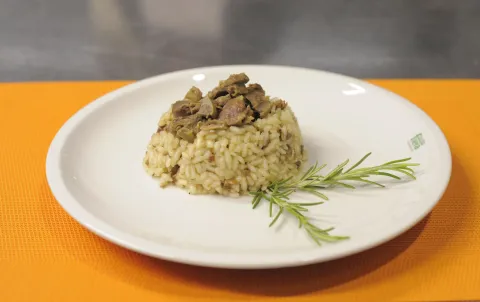
Rice was introduced to Venice from the East, and soon became the emblem of wealth, abundance and fertility, symbolism still reflected today in the tradition of throwing rice over the bride and groom at the end of a wedding ceremony. Rice dishes have long signified hope on the tables of the poor in Veneto - rice and fegatelli (pork livers) has been served at rural weddings for centuries - as well as on the tables of the upper classes.
The typical dish of the Dogi served in celebration of Saint Mark, Patron Saint of the Republic, was risi e bisi (rice and peas), a recipe that still remains very famous. Cultivation began in the sixteenth century, buoyed by considerable tax incentives applied by the Serenissima Republic of Venice. It was first grown on the Verona plain at the beginning of the seventeenth century, and has had a considerable influence on the landscape and local traditions. Major irrigation systems were built so that long channels could carry pure water drawn from springs to the fields, a precious commodity for the growers. Along its path, water was also used to generate motion required by rice basins, mills and other small works.
Rice growing in the Verona area has always focussed on top quality varieties and growing practices have been refined over the years, with traditional methods being improved by modernisation. The Vialone Nano variety was a welcome arrival to the area and its outstanding quality prompted the Protection Consortium to apply for the European indication. Rice is a special product for the people of the Veneto Region, as it was introduced by the Eastern communities who had settled in Venice and enjoyed flourishing trades there. It soon became a traditional food, to the extent that regional cooking methods are unique. Here, rice is to be served ""all'onda"" (like a wave), cooked in just a little liquid, so the grain takes on the flavour of the other ingredients but remains ""al dente"".
It has to remain soft - like a wave - after it has been ""bound"" with butter and in some cases a sprinkle of grated Grana cheese. The secret to these recipes lies in the traditional, gentle but astute process that gives the grain of the nano vialone veronese its hint of a darker tone, preserving its distinctive flavour and making it so hard to overcook. The coarse rice is dried, grains are whitened by a mechanical process and finally the best rice is selected by removing impurities and even the slightest defects. The result is a white grain with no stripes and with a discernible central ""pearl"".
The designated region of cultivation is very extensive, and features architectural and cultural places of interest that lie along the route of the Strada del prodotto tipico (Typical-product Road). There are many fifteenth century Venetian style homes still found on the plain of Verona. The homes of landowners, Patron or Paron as they are known locally, were once located at the heart of large farms, but were later transformed into luxury country residences for the city nobility, who adorned them with frescos, statues and gardens. In the sixteenth and seventeenth centuries, humanistic gardens took on the semblance of vegetable collections with plants being cultivated for their pharmacological properties. In the nineteenth century, many of these were made into flowing English-style gardens. Villas with such gardens can be seen in Isola della Scala (Villa Giuliari), in Cerea (Villa Dionisi) and several other towns in the plain of Verona.
The landscape is also dotted with several churches that were rebuilt after the earthquake of 1117, with a Romanic style, reusing Roman or Longobardi materials. An example is the Chiesa della Bastia in Isola della Scala.
Also deserving of special mention is the important fine furniture district located in the area, where artisan workshops reproduce classical furniture or restore original pieces.
PGI Radicchio Variegato di Castelfranco
The history and tradition of the radicchio variegato di Castelfranco is closely entwined with the late radicchio rosso di Treviso. Its origins almost certainly point to the latter being crossed with endive in Castelfranco Veneto. Its characteristic broad, thick, creamy-white leaf can be ascribed to endive, while its intensely colourful, brighter variegation and suitable for the forcing blanching process would appear to derive from the late red typology.
The result is delicious to the palate and pleasing to the eye, so much so it became known as the ""rose of Castelfranco"" or ""edible flower"". This affectionate description is especially fitting for the mature plant after the finishing process. The head typically has white-creamy variegated leaves distributed evenly throughout the leaf, in different tones from a pale violet to violet-red and bright red, with jagged edges and slightly wavy blade. The leaf has a dense consistency in the mouth. Its flavour is delicate, ranging from sweet to pleasantly bitter. Locally, it is traditionally eaten raw as a simple salad like all the radicchio di Treviso typologies. It can also be used in many other ways, for example as a base for a mixed salad or with a special dressing, or as an ingredient for risotto, soup, cooked or even fried.
The ground is cool, deep, well drained and quite sparse of nutritional elements in its designated area of production, which includes the provinces of Treviso, Padua and Venice. Heads are harvested at the beginning of October, but onl the production method is able to enhance the organoleptic qualities and appearance of the product, which at the end of a long process is presented in homogeneous, compact heads about 15 centimes in diameter that stand on short stalks.
The natural and cultural wealth of the area is very visible along the Strada del prodotto tipico (Typical-product Road). The Sile river flows by beautiful landscapes, where the indigenous flora and fauna of the Regional Park welcome walkers or cyclists, inviting them to enjoy the serene paths that run alongside the embankments. There are many examples of Veneto architecture here, dating from the Renaissance onwards. But it is the historical centres of the two cities, Treviso and Castelfranco Veneto, which attract the greatest number of tourists with their rich and diverse cultural offer.
PGI Radicchio di Chioggia
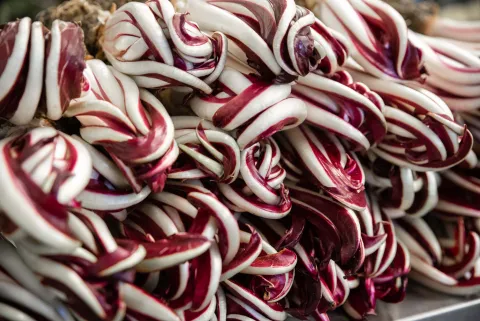
It is a son to the more famous Radicchio di Treviso, the first in Europe to be the proud holder of Protected Geographical Indication (PGI) mark, and is recognizable by its very compact spherical shape, more or less intense red leaves with white central ribs that call to mind those of a rose.
The Radicchio di Chioggia PGI is named after the place from which it gets its fame, the lovely lagoon city of Chioggia, south of the Venetian lagoon, but is also cultivated in other municipalities in the provinces of Padua, Rovigo and Venice.
Exported throughout Europe, it is a typical product with ancient traditions as found in the monthly notebook of Federal Credit Institute for the Risorgimento of the Venezie (March 1923), in the book ""Introduction to Horticultural Economics"" Pagani-Gallimberti, which explains the radicchio cultivation technique in lagoon vegetable gardens, and finally in the study ""Experimental Vegetable Gardens of Chioggia"" (1935) featuring researches on new varieties of vegetables and chicories including the radicchio.
Produced in the ""early"" and ""late"" types, this crisp and slightly bitter tasting vegetable is rich in fiber, vitamins, calcium, phosphorus and magnesium, with antioxidant, anti-radical, diuretic, and cleansing properties.

PGI Marostica cherries
The oldest known document making reference to cherry growing in Marostica, a town famous for its annual chess game, dates back to the early fifteenth century. Cherry farming has always played an important role in this area and in the local agricultural economy. Buyers have been able to choose from cherries from this and neighbouring areas at the local specialist market held in Mason Vicentino since the 1950s.
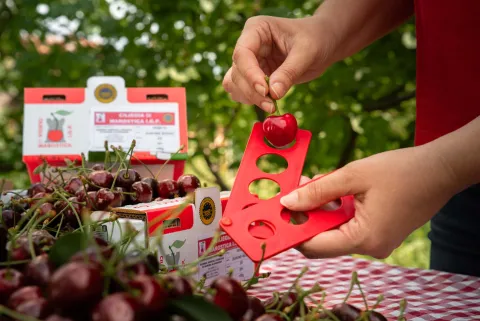
The Protection Consortium was established in 1957. It continues to group and deliver the cherries grown on 460 hectares of land, almost exclusively on the fertile and rich soil of the hilly region that produces sweet and delicious fruits. The Marostica cherry P.G.I., the only Italian kind to bear this precious geographical indication, is heart-shaped and is picked by hand without removing the stalk, a technique which represents a small, yet meaningful quality guarantee, helping the fruit maintain its short-term organoleptic properties. The Marostica cherry grows to a size of between 21 and 30 mm and its colour can be anywhere from pink to dark red according to the variety. It is juicy and has a full, sweet and very palatable taste.
The best-selling varieties are Sandra, Romana, Francese and the distinctly sweet Duroni rossi. Their characteristics include a short period between setting and ripening of only thirty days, and, at the same time, excellent fruit size. Such rapid growth and ripening reduce exposure to environmen-tal agents and parasites (especially to the cherry fly) thereby reducing the need for measures to protect the plant and guaranteeing a better quality. Most of the varieties are easily preserved and boast good resistance to handling, making the fruit particularly suited for exporting.
The growing area stretches across hills strewn with old towns, such as Marostica, with its Upper Castle, Lower Castle and city walls, all built in the fourteenth century. The historical centre is home to numerous palaces and religious buildings, such as the charming seventeenth-century Carmini Church, the San Marco Church, built by the Venetians in honour of the Patron Saint of the Republic, and the Sant'Antonio Abate Church.
In even-numbered years in early September, the world famous human chess game is played with living pawns in the famous Piazza degli Scacchi in front of the Doglione Palace and Lower Castle. Seven hundred people, including characters and staff, become involved in a wonderful game of light and colour, with strolling players, ladies and knights; every edition drawing a larger audience.
The game dates back to 1454 when it was organised to settle a courtly duel between two noble lords competing for the hand of a lady, the daughter of the Lord of the Castle of Marostica. The match is represented today in the full splendour and costume of the day.
Marostica is also known for the Sagra delle ciliegie, a local cherry festival celebrated on the last Sunday in May every year. This event celebrates the ""red gold"" of Marostica, the first spring fruit. Throughout the harvest season cherrybased delicacies are served in the most traditional restaurants of the area.
PGI Badoere Asparagus
The Badoere Asparagus is a vegetable that boasts a long tradition from the Treviso region with origins probably dating back to Roman times. Literary records also show many sources as stating that the Badoere Asparagus is one of the most prestigious products from the Veneto region.
Two types of delicate shoot; there is the white shoot (5 varieties) and the green shoot (5 varieties) The white shoot has a sweet flavour, neither bitter nor salty, tender and not fibrous; the green shoot on the other hand has a more marked flavour, neither bitter nor salty with a persistent fruity and herbal aroma.
A delicacy for the palate and healthy too: The asparagus is rich in vitamins and minerals, offering cleansing and diuretic properties and is particularly recommended in slimming diets. The production areas can be found in the Treviso region (with the municipalities of Casale sul Sile, Casier, Istrana, Mogliano, Morgano, Paese, Preganziol, Quinto, Resana, Treviso, Vedelago, Zero Branco); it is also grown in the municipalities of Piombino Dese and Trebaseleghe in the Padua area and finally in the Venetian area (Scorzè).
With this new recognition the Treviso province can now boast two asparagus with the Protected Geographical Indication (there is also the asparagus of Cimadolmo) together with the Vicenza PDO for the Bassano Asparagus.
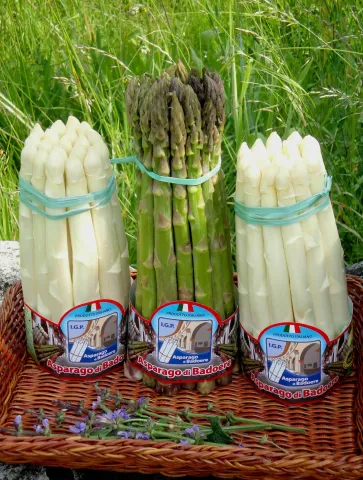
PGI Lusia salad
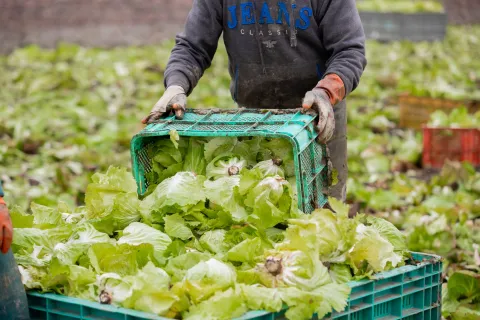
In around 1960 the traders from the Lusia area (in the municipality of Rovigo), thanks to trade with the fruit and vegetable market of Verona, discovered the lettuce ""Lattuga Gentile"" and encouraged its introduction into local fruit and vegetable farms.
As a result of the good soil and climate, they achieved optimum quality and quantity prompting the producers to start a selection to single out the varieties that offered the best in the organoleptic characteristics of this lettuce.
The production area of the IGP Lusia salad covers all areas in the municipalities of the Rovigo province: Lusia, Badia Polesine, Lendinara, Costa di Rovigo, Fratta Polesine, Villanova del Ghebbo, and Rovigo. It is also grown in the Padua province in the municipalities of Barbona, Vescovana and Sant'Urbano.
The stem is short, up to 6 cm, very fleshy, bearing leaves inserted in number, shape, size and colour depending on the climate; the taste is fresh and crisp.
This product is characterized by its softness, due to the absence of fibres and retaining turgidity' even up to 10-12 hours after picking, and the absence of woody characteristics.
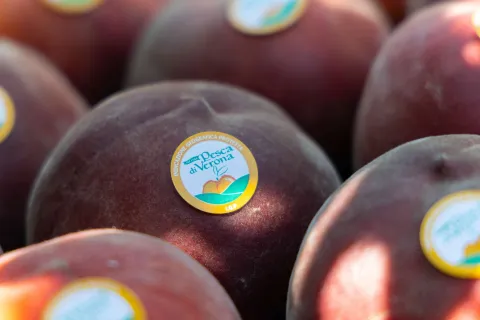
PGI Verona Peach
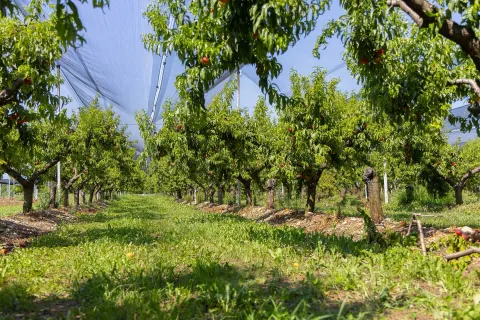
Originating from China, the peach reached the Mediterranean as a result of the conquests of Alexander the Great. There is evidence as far back as the Roman era of the peach also in the Verona areas and since 1500 more specifically on the shores of Lake Garda.
Currently, production of the Verona Peach has a protected status (PGI) and is confined to the Verona province, in particular covering all municipalities of Bussolengo, Buttapietra, Castel d'Azzano, Mozzecane, Pastrengo, Pescantina, Povegliano, S. Giovanni Lupatoto, Sommacampagna, Sona, Valeggio sul Mincio, Villafranca, Castelnuovo del Garda, Lazise, Sant'Ambrogio di Valpolicella, San Martino Buon Albergo, Verona, and Zevio.
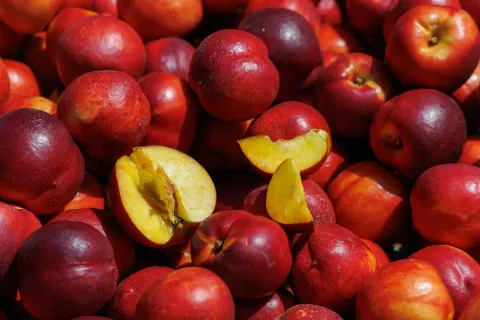
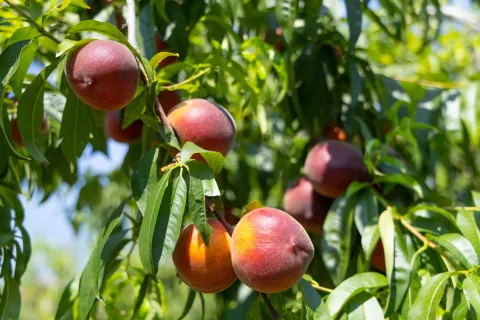
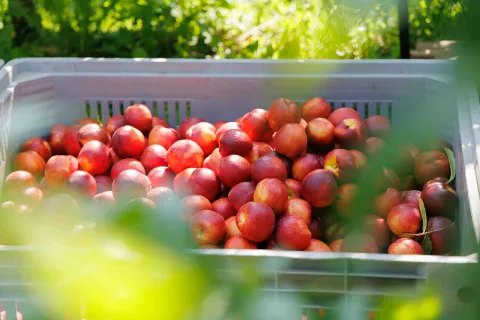
Boasting a beautifully velvet skin and delicate taste, this peach reaches its peak in the summer offering a sweet and juicy fruit with vivid colours.
The typical peaches of Verona are only those with a white or yellow pulp, and yellow pulp nectarines, of early, late and medium ripening.
The skin colour of the fruits is very bright and intense, the pulp is firm and succulent, with a characteristic flavour due to the right balance between sugar levels and acidity linked to the limited growth of the plants and in particular to the favourable climate, sheltered by the hills and the temperate area of Lake Garda.
PGI Combai Chestnut
The production and conditioning area of the combai chestnuts covers the following municipalities in the Treviso province: Cison di Valmarino, Cordignano, Follina, Fregona, Miane, Revine Lago, Sarmede, Segusino, Tarzo, Valdobbiadene and Vittorio Veneto. The physical and organoleptic characteristics of the Combai Chestnuts are strictly linked to the geographic production environment.
The orography of the territory and the characteristics of the ground are the main reasons that make this area particularly suitable for quality chestnut production. The presence and special qualities of these chestnuts can be found in area from Segusino to Cordignano, with Combai as its centre, confirmed by numerous historical testimonies dating dates back to the XII century.
The historical papers gathered, spanning the period from 1200 to 1700, identifies the Treviso foothills to the left of the Piave as an area naturally suited to chestnut growing, as further confirmed by the many place names. In more recent periods, the value of the Combai Chestnuts has been brought to the fore by the Pro Loco Combai thanks to the Combai Chestnut Festival, which since 1945 constitutes an important event at both a local and national level.
PGI Radicchio Rosso di Treviso
This is a unique and incomparable product, typical of the rural culture of the Treviso area.
An 1862 almanac, L'Agricolo, claimed that the month of December was for ... «earthing up cabbage and broccoli, and for whitening red and white radicchio covering the ground with dead leaves». This seems to be the first official report of red radicchio being covered to turn it white.
This technique, suggested by nature itself and used for centuries in Veneto, was soon perfected.
The late typology of radicchio di Treviso is locally known as radìcio spadón or sword-shaped. This regal characteristic is no less important than its bright purple-violet colour, and can claim equal responsibility for its global renown. It has a fresh and delicate flavour, its fragrant and noble, fragile, slender leaves stubbornly enclose the heart in a defensive grasp, the red flower does not give up its leaves easily. It is a delicacy to savour with all the senses, a prize for the cook and the person who eats it alike. Its leaves crunch in your hands and are soft to the touch.
It never fails to astonish with its subtle undertones of spring water and bitter taste: this is late radicchio di Treviso! It is preferably eaten raw so its qualities can be enjoyed to the full, perhaps accompanied by other delicate flavours to compliment it.
The production area encompasses a large territory spanning the provinces of Treviso, Padua and Venice, an area characterised by slow-moving rivers and tributaries, making the land fertile and productive. The two typologies of radicchio, early and late, are grown on deep, well-drained soil.
The precoce or "early" typology can be harvested from the first of September and, thanks to a special binding, it has a long, firmly-closed voluminous head with shining red leaves broken up by thin white veins. The tardivo or "late" typology is harvested from the first of November and then subjected to a forcing process that gives it a characteristic, flavoursome taste. The forcing-blanching process is essential for underscoring the organoleptic value of the late typology.
The heads are collected in special covered vats that let little light in. The roots are set in spring water: gentle and constant, the flow of warm water washes and refreshes all the roots, helping the plant once again grow. Using only the reserves of the large root accumulated during the summer as its food source, it once again grows new, tender and crunchy leaves without light, therefore without any source of chlorophyll pigment, highlighting its intense red colour, and losing its fibrous consistency, becoming crunchy and pleasantly bitter.
The "winter flower" has bloomed, hidden and protected by summer leaves that are sacrificed in a charitable attempt to keep the cold at bay. This is the moment when the expert hand of man comes into it: the heads are left for a few days to dry at a mild temperature on sand or straw, and then delicately freed from their outer leaves and peeled, leaf after leaf, until the ""heart"" appears in all its splendour; the root is beautifully carved, with a special, very sharp and slightly curved knife, before being trimmed according to the size of the "flower".