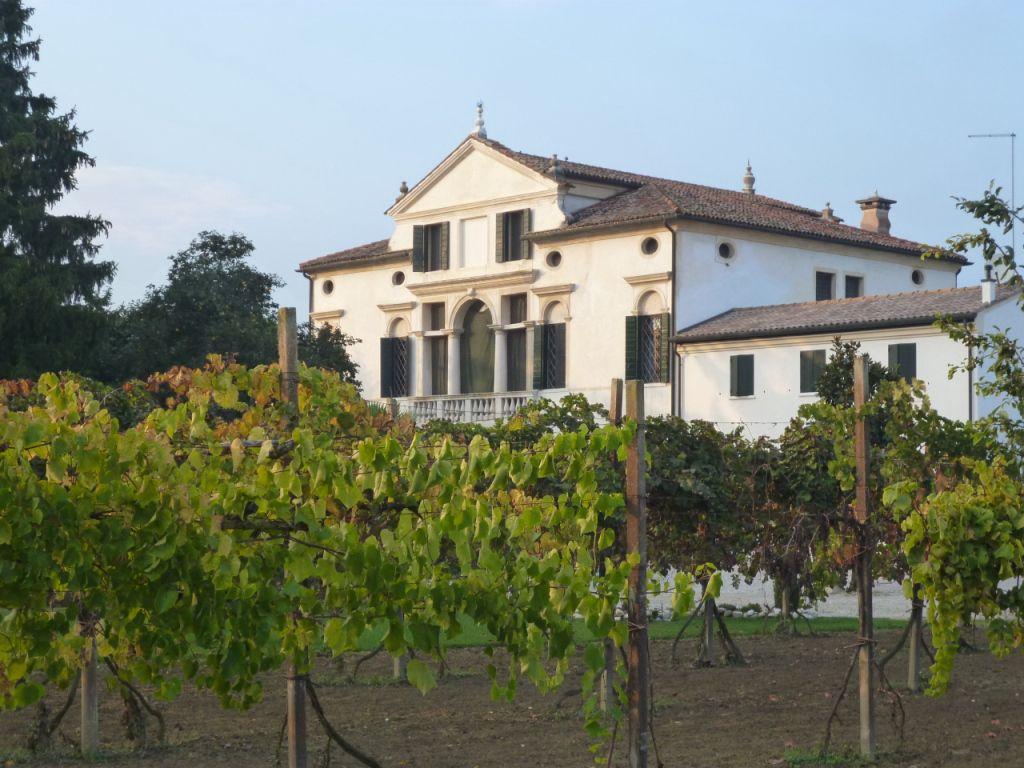
The villa features motifs derived from the Venetian palaces of the second half of the 16th century, both in its tripartite plan and in its façades. The south façade opens onto the main entrance of the park, while the north façade symmetrically opens onto the courtyard and the countryside behind. In the 1781 cadastre, it is recorded as belonging to the Lin family, wealthy grocers of Bergamasque origin who were granted patrician status in 1686, having bought a palace at the Grand Canal from the Mazzoni in 1691 (now Palazzo Morolin adjacent to Palazzo Grassi). Notable are the Lin family's investments in mainland properties: agricultural lands, manorial houses, and villas. In the early 1800s, a financial collapse led many assets to be auctioned off. The villa came into the possession of Ing. Meduna, the Mattiazzi, the Trevisan, and the Bottacin families. It currently belongs to the Santon-Boer family, who have overseen its complete restoration and reside there.
Highlights of the villa: The central body of the villa, crowned by a tympanum and pinnacles, has remained unchanged while the barchesse, originally used as stables and barns, have been recovered and integrated as living spaces. The main façade is adorned with semi-columns of Tuscan order and a balustrade balcony in Istrian stone with a wide serliana. Small oval windows, typical in the 1600s, illuminate lowered attics on either side of the tympanum, which rises above the quadrant of the sundial with two short marble volutes. On the north façade, one can see the protruding chimney pipes between lateral windows and a large central arched window, reminiscent of the openings on the main façade, but without a balcony.
Inside, there is rich decoration of stucco and a cycle of frescoes in the Tiepolo style attributed to Zugno, featuring historical-symbolic subjects with the recurring icon of Dogaressa. The Venetian-style floors in the hall and other rooms are original. All the doors have Istrian stone frames and overdoors decorated with panels and 18th-century stucco. Many ceilings feature Sansovino beams with fragments of original pictorial motifs. The park in front of the villa is enclosed by a gate with columns and statues, a low wall, and a small ditch. Period furnishings.
Highlights of the context: Villa Lin is located on Via Ca' Lin, which intersects Via Castellana in the Trivignano area, a provincial connection between Venice and Castelfranco Veneto. It is the closest visitable Venetian villa to the city of Venice (15 km away). The context in which Villa Lin is situated has significant environmental and cultural interest, also due to its proximity to the cities of Treviso and Padua, as well as to the numerous Venetian villas along the Terraglio and the Riviera del Brenta. The area offers excellent food and wine tours, particularly known for its agricultural and wine production.
<p>Timings to be agreed upon at the time of booking <br>Visits: It is possible to visit the villa in all its parts by prior telephone booking for a guided tour. <br>Entrance ticket: Group guided tours (minimum 10 people) Euro 7/person. <br>Guided tours with tasting Euro 12/person. <br>Overnight stays starting from Euro 30/person, varying according to the season and duration of stay. Shuttle service available for a fee. </p> <p> </p>
Villa Lin, Bottacin - Villa Ca' Lin Santon - Boer Catalog number IRVV (Regional Institute of Venetian Villas): A0500002992