Veneto excellence

Riviera del Brenta D.O.C.
The most ancient findings indicating vineyards and winemaking in the area between the provinces of Padua and Venice, between the banks of the Brenta river and the ""Graticolato romano"" (Roman allotments) area, are associated with Etruscan and Roman traditions.
New, more prestigious and specialist grapevines were planted in the days of the Serenissima Republic of Venice, when Venetian nobles would stock up with goods for their numerous, majestic feasts; and wines from these lands were welcome on the tables set for feasts with the Dogi.
The D.O.C. white wines are: Riviera del Brenta Bianco - with a mixture of grapes composed of Tocai friulano (minimum 50%) and other white grapes - Riviera del Brenta Chardonnay and Riviera del Brenta Pinot bianco (also sparkling and spumante), Riviera del Brenta Pinot grigio and Riviera del Brenta Tai.
The D.O.C. red wines are: Riviera del Brenta Rosso - with a mixture of grapes composed of Merlot (minimum 50%) and other red grapes - (also in novello and rosé versions), Riviera del Brenta Cabernet, Riviera del Brenta Cabernet riserva, Riviera del Brenta Merlot, Riviera del Brenta Raboso, Riviera del Brenta Raboso riserva, Riviera del Brenta Refosco dal peduncolo rosso and Riviera del Brenta Refosco dal peduncolo rosso riserva.
Riviera del Brenta was described in the eighteenth century as almost a suburb of Venice, where the river is an ideal extension of the Canal Grande. The villas of the nobility, numbering about 80, magnificent architectures and romantic gardens reflect in the meandering river, representing a unique historical, cultural, artistic and environmental centre that have inspired many renowned writers and poets, and which many famous painters have immortalised in their paintings.
There are several traces evoking a peaceful past atmospheres in Dolo, a pretty town in the middle of the Riviera, expression of the magnificence of the Serenissima Republic of Venice. least four months. The acid undertone of Durella is reduced by the high concentration of sugar in this wine which assumes unmistakable accents.
Other D.O.C. wines are: Monti Lessini Bianco, Monti Lessini Bianco superiore, Monti Lessini spumante, Monti Lessini spumante rosato or rosé, Monti Lessini Rosso and Monti Lessini Rosso riserva.
The enchanting valleys of Lessinia offer the perfect itinerary for the Strada del Vino (Wine Road), where visitors can discover the region that has historically been home to and still is home to this extraordinary grapevine. The Road links towns with great wine-making traditions, offering architectural and panoramic points of interest along the way, including one of the most famous fossil sites known to the world, Bolca.

Venezia D.O.C.
The list of Veneto controlled designation of origin wines is enriched by the introduction of ‘Venice’ wines, which were granted the DOC label in 2010.
According to the production conditions regulation, wines of the following types can be provided with the quality label: Red, Merlot, Cabernet-Sauvignon, Cabernet franc, Chardonnay, Pinot grigio, Bianco spumante, Bianco frizzante, Rosato, Rosato spumante and Rosato frizzante. The ampelographic base includes grapes from the vineyards located in the provinces of Venice and Treviso in which the varieties of Merlot Cabernet-Sauvignon, Cabernet franc, Chardonnay and Pinot grigio correspond to at least 85%. With regard to the rosato or rosè wines (also in the spumante and frizzante version), production occurs with at least 70% of grapes originating from the Raboso Piave or Rabose veronese vines. At least 50% of the Venezia Red DOC comes from Merlot grapes, while for the Bianco frizzante and the Bianco spumante at least 50% of the composition is obtained from Friuli Verduzzo or Treviso Verduzzo or Glera.
Also with regards to the standards relating to cultivation and vinification techniques, the key word is ‘tradition’: only the local traditional practices are in fact allowed, with activities that ensure the characteristics of the grapes and wines remain unchanged.
Valpolicella Ripasso D.O.C.
Valpolicella is a geographical area at the feet of the Verona ‘Pre-Alps’, surrounding the valleys where the Negrar, Marano and Fumane streams flow. These descend from the peaks of the Lessinia mountains until they run into the Adige.
The Valpolicella Ripasso is one of the productions in this context, a recent entry to extend the list of DOC wines offered by this area’s excellent wine growing and producing business. From March 2010, all the different types and specifications of Valpolicella Ripasso wines can be provided with the D.O.C. label: Valpolicella Ripasso Classico, Valpolicella Ripasso Superiore, Valpolicella Ripasso Classico Superiore, Valpolicella Ripasso Valpentana and Valpolicella Ripasso Valpentana Superiore.
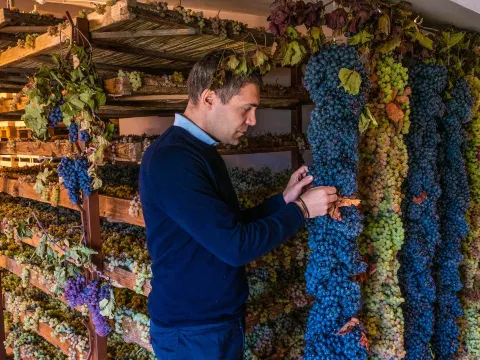
The name ‘Ripasso’ refers to the particular production technique. The grapes used are the same ones used for making Amarone and Recioto wine, where the term ‘same’ should be interpreted literally: after having been used for the production of amarone and recioto wine, in which the grapes are pressed in a reduced way, the vinasses are in fact added to the vat of Valpolicella classic in order to re-ferment for 10-15 days. This operation is called precisely ‘ripasso’ (i.e. re-pass, re-ferment) and produces a high quality wine. The organoleptic characteristic are: intense red colour tending to garnet; characteristic smell; full bodied, velvety taste.
Valpolicella D.O.C.
Valpolicella is the name of a geographical area comprising three valleys crossed by the Negrar, Marano and Fumane streams, which flow down from the Lessini mountains into the Adige river. The area defined as ""classica"" is the oldest of the wine-making districts, offering fertile soil in a lush, full landscape once described as ""the garden of Verona"". The original centre was extended over time and today the area of provenance encompasses the hills near Verona that run from Sant'Ambrogio alla Valpantena to the valley of Cazzano di Tramigna, an abundant and charming area where vines grow alongside cherries and olive groves.
Ernest Hemingway defined this wine as « light, dry, red and sweet, just like the home of an agreeable brother ».
Travelling much further back through the ages to the fifth century B.C., however, many references to Valpollicella are made as ""Retia"", and the wine produced from its soil ""Rético"" - a wine made from dried grapes mentioned for its undisputed quality in classical works of literature by Virgil, Martial, Pliny the Elder and Columella. It would appear that passito wines or ""recioti"" were also described by Cassiodorus, secretary to the Ostrogothic King Theodoric (fifth century) who described it as ""Acinatico"". The grapes used to make the wines come from the Rondinella, Molinara and Corvina veronese species of vine, in percentages ranging from 20 to 40% for the first, from 5 to 25% for the second and from 40 to 70% for Corvina. Other grapes such as the Negrara, Barbera and a few others are used in a percentage from 5 to 15%.
Wines included in this D.O.C designation are: Valpolicella, Valpolicella classico, Valpolicella superiore, Valpolicella classico superiore, Valpolicella Valpantena, Valpolicella Valpantena superiore, Recioto della Valpolicella, Recioto della Valpolicella classico, Recioto della Valpolicella spumante, Recioto della Valpolicella Valpantena, Recioto della Valpolicella Valpantena spumante, Amarone della Valpolicella, Amarone della Valpolicella classico, Amarone della Valpolicella Valpantena and Amarone della Valpolicella riserva.
More recent modifications to the official guidelines state that the Valpolicella, Valpolicella classico, Valpolicella superiore, Valpolicella classico superiore, Valpolicella Valpantena and Valpolicella Valpantena superiore wines may be re-fermented from the skins left over from the preparation of Recioto wines from Valpolicella and/or Amarone della Valpolicella. These wines may use the addition designation of ""ripasso"".
Amarone - a wine that has become very popular and that is well appreciated around the globe - has close ties to Recioto. It is ruby red, tangy and dry, with bitter tones acquired after fermentation.
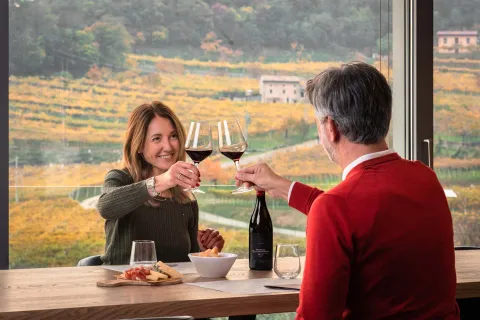
The Strada del Vino (Wine Road) proposes many itineraries through a number of towns, which are suitable for walking, riding bicycles or mountain-bikes. They span captivating landscapes which, together with the vineyards, are enchanting and delightful attractions in these valleys. Valpolicella preserves the marks of its history in monuments and buildings that can be fully appreciated even today, and that provide a perfect illustration of the passage of time in Romanic rural churches. Wonderful examples are the San Floriano and San Giorgio ""Inganapoltron"" churches, where recent excavations have uncovered the original structure of Roman temples.
Vicenza DOC
The culmination of the venerable knowledge enjoyed by Vicenza wine-growers, these wines can surprise and excite because they encompass the Vicenza area in the broadest sense, from the Berici Hills to the foothills, a historic sight for wine-growing traditions.
The white wines of this D.O.C. are: Vicenza Bianco (also sparkling, spumante and passito), Vicenza Chardonnay, Vicenza Chardonnay spumante, Vicenza Garganego (from the Garganega grape), Vicenza Garganego spumante, Vicenza Pinot bianco, Vicenza Pinot bianco spumante, Vicenza Pinot grigio, Vicenza Manzoni bianco, Vicenza Riesling (from Riesling renano and/or Riesling Italico), Vicenza Sauvignon, Vicenza Moscato and Vicenza Moscato spumante (from Moscato bianco and/or Moscato giallo).
The D.O.C. red wines are: Vicenza Rosso, Vicenza Cabernet (from Cabernet franc, Cabernet Sauvignon and Carmenère) Vicenza Cabernet Sauvignon, Vicenza Merlot, Vicenza Pinot nero and Vicenza Raboso (all also as riserva), Vicenza rosato (rosé) and Vicenza novello.
San Martino della Battaglia D.O.C.
A small geopedological and climatic niche, bordering the moraine hills and the hinterland to the south of Lake Garda, partly overlapping with the D.O.C. Lugana and Garda designations, is the area of provenance for the Tocai friulano grapevine.
Over time the vine has managed to survive the external influences in the region, the same influences which have favourite the diffusion of other white and red varieties. The reasons why local wine-growers have protected the Tocai are certainly linked to the qualities of this grapevine rather than the quantities it produces, which are always very limited.
The soil in some places is pure stone on these hills, but the grape has adapted perfectly to reach its full potential. It is the limited harvest and the refined wine-making techniques that make it possible to create wines with a very palatable aroma.
D.O.C. wines are: San Martino della Battaglia Bianco and San Martino della Battaglia liquoroso (liqueur wine).
San Martino della Battaglia Bianco is a citrine yellow colour, with a tendency towards gold with refinement. Its fragrance is mature, pronounced and well-typed; it is refreshing and dry with a light almond aftertaste.
San Martino della Battaglia liquoroso is yellow tending towards gold with refinement, with a pronounced and welltyped aroma and a pleasantly sweet, velvety, well-orchestrated and full-bodied taste, with subtle almond aftertaste and at times hints of wood from refinement in the barrel.
The area has much to offer in terms of nature, art and history. It is possible to uncover traces of past populations and dominations, from the ancient Romans who settled in Peschiera to the time of the Serenissima Republic of Venice, from the Napoleonic France to the Habsburg. These lands were also theatre of many battles during the Risorgimento.
Terradeiforti Valdadige D.O.C.
This area borders the provinces of Verona and Trento in the Valley of Adige, and counts 1,300 hectares of specialised vineyards, 20 wineries and 1,000 wine-growers, the majority of which are faithful to tradition, conveying sensations and emotions of bygone days to the present. This pearl set between Veneto and Trentino extends along the banks of the Adige river, a valley shaped by quaternary glaciers and carved by the river that flows to the south from the Ceraino narrowing and opens up to the north between Mount Baldo and the Lessinia mountains, reaching the province of Trento.
It encompasses the municipalities of Rivoli Veronese, Brentino Belluno, Dolcè and Avio, connected by the Adige river, and the rows of vineyards. Early evidence of winegrowing in this area date to the first century A.D., when Pliny the Elder, visiting the Verona area, described the surroundings as «... labruscae: hoc est vitis silvestris quod vocatur
oenanthium...», making reference to Enantio, one of the local red wines made with native grapes.
White wines belonging to this D.O.C. are: Terradeiforti Valdadige Chardonnay, Terradeiforti Valdadige Pinot grigio and Terradeiforti Valdadige passito from the Chardonnay grape. The D.O.C. red wines are: Terradeiforti Valdadige
Casetta, Terradeiforti Valdadige Casetta riserva, Terradeiforti Valdadige Enantio, Terradeiforti Valdadige Enantio riserva and Terradeiforti Valdadige Enantio passito.
Valdadige D.O.C.
The D.O.C. area extends over a very vast territory, from the Ceraino narrowing in the province of Verona, where the Adige river begins its journey towards the plains, to Bolzano. Valdadige has been a historically important connection and area of economic development since Roman times, when two roads were built on the opposite banks of the river, Via Claudia Augusta Padana from Ostiglia, and Via Claudia Augusta Altinate from Altino, near Padua. Barbarian invasions later forced the inhabitants to flee to higher altitudes, where they farmed sheep and used the resources of the woods to survive. Monasteries and dominions shaped the area in the Middle Ages with convents and castles, which contributed to the flourishing farming era, with grapevines playing an important role.
The D.O.C. wines are: Valdadige Bianco, Valdadige Chardonnay, Valdadige Chardonnay frizzante (sparkling), Valdadige Pinot bianco, Valdadige Pinot bianco frizzante (sparkling), Valdadige Pinot grigio, Valdadige rosato (rosé), Valdadige Rosso and Valdadige Schiava.
Valdadige is dotted with numerous castles, monasteries and churches which provide testimony to the extensive cultural wealth of this area. The valley preserves the past in its numerous fortresses and theatres of great battles, such as the battle Napoleon fought against the Austrians in Rivoli in 1797. Fortresses, castles and forts follow the contours of the ridges overlooking the valley and trace the course of history playing host to several armed forces. As many as eight forts were built between 1848 and the end of the century by the Austrians and Italians, which acted as watch outposts overlooking the valley, and have now become an integral and defining part of the landscape.
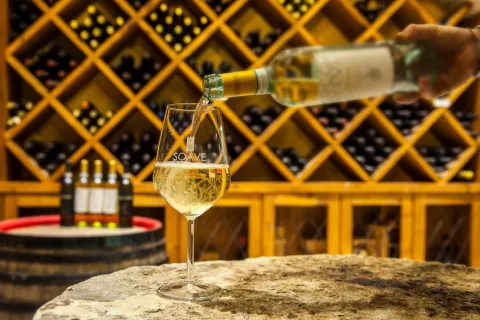
Soave D.O.C.
This area - the largest vineyard in Europe covering its 6,600 hectares on the hilly range in the eastern section of the province of Verona - was the first area to obtain the D.O.C. designation in Italy in 1936. In more recent years, it was awarded two additional quality designations, the top indication where wine is concerned: Recioto di Soave D.O.C.G. and Soave Superiore D.O.C.G. The oldest areas of provenance, located on the hills between the municipalities of Monteforte d'Alpone and Soave, was defined in 1931 and corresponds to the Soave ""classica"" area, while the Colli Scaligeri sub-area goes from San Martino Buon Albergo to Roncà, including the valleys of Val di Mezzane, Val d'Illasi, Val Tramigna and Val d'Alpone. In this entire area, the maximum quality expression of the Garganega grape is attained from the grapevines, so much so that the area is identified by the grape and the grape by the area, creating a unique and singular tie.
Soave appears to derive from ""Suaves"", a name used to denominate the Suevic who settled in Italy under the rule of the Lombard King Alboin. The area was already known for its agricultural qualities in Roman times. It was a ""pagus"", a rural district contained within boundaries and perhaps divided into centurie (Roman allotments), renowned for its good locatio and the concentration of its cultivations. During the Middle Ages - when the Castle of Soave was built - wine-growing became increasingly important in this area.
As curious testimony of how wine entwines with the history of this area and how important the grape harvest was for the inhabitants of Soave in the fourteenth century, an engraving was made on a stone wall beneath the balcony of the Soave Court of Law, proudly claiming « This court of law was built seventy five years after the year one thousand and three hundred [...] when the people of the town pressed grapes with their feet ».
The D.O.C. wines are Soave, Soave classico, Soave spumante and Soave Colli Scaligeri.
Soave derives from a practised combination of Garganega grapes - at least 70% - with the Trebbiano di Soave, Chardonnay and Pinot bianco grapes, making up to 30% of the total. This blend makes for a straw yellow wine with some hints of green, an intense and delicate fragrance, and dry, medium-bodied, well-orchestrated and slightly bitter taste. Its geographical location and proximity to the main paths of communication to the south, and the historical and monumental importance of the territory, make Soave the third most important centre of interest in the Verona area, trailing only Verona and Lake Garda.
The Strada del Vino (Wine Road) connects vineyards and parish churches along an idyllic fifty kilometre itinerary, offering visitors beautiful landscapes and the chance to visit Roman churches, villas, castles and museums.